Game: Atomic Bomberman
Atomic Bomberman PC
Tuesday, April 6, 2010 at 11:15 AM Posted under Tags: review08, Siew Khim
Game: Atomic Bomberman
Bubblewrap
Tuesday, March 30, 2010 at 4:39 PM Posted under Tags: Kelvin A, review08
BUBBLEWRAP
A very irritating IPhone game but very much usefull when you are about to kill people waiting for busses that come every half an hour because of the ever-slow land transportation system in Singapore.
There is a similar art work in Jakarta Biennale 2009 where the artist installed bubblewrap in bus stations. Believe me, it works damn well. And how irritating it can be to listen to bubblewrap being burst under the extremely humid and hot sun of Jakarta. Well, now you have the bubblewrap in IPhone!
A simple game where players have to exercise their fingers and speed to burst as many bubblewrap as possible. When you burst 290 and more, you made it to the international rank! How amazing is that.
Well, this game is fun, active, interesting, funny and helpful. Very smart, brilliant, simple, etc etc etc.
I think too, this game is an example of how a simple thing can be developed into an interesting game which will make people play and play. I believe that this kind of game, or more like entertainment or finger exercise platform will last. Short gameplay but lasting impression. Brilliant
kelvin
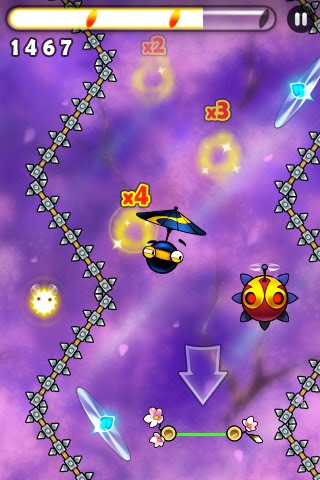
Parachute Ninja: Iphone/Ipod Game
Thursday, March 18, 2010 at 12:53 PM Posted under Tags: review08, Sarah ZA
STOBLOBS - YUNIZA KHOO
Wednesday, March 17, 2010 at 1:15 AM Posted under Tags: review08, Yuniza
Where We Remain / FlxAdventure
Tuesday, March 16, 2010 at 4:34 PM Posted under Tags: Benjamin, review08, review09

Developer: TwoFold Secret
Platform: Flash

Discussion thread: http://forums.tigsource.com/index.php?topic=9684.0
Developer: SeiferTim
Platform: Flash
Where We Remain and FlxAdventure are both role-playing games with a top-down perspective. The controls are similar: the arrow keys move your character (although FlxAdventure uses the same controls for more than movement). The graphics use similarly chunky 8-bit aesthetics. What's most interesting is how both games reveal the game mechanics to the player.
In Where We Remain, you play an enigmatic man trapped on an island. When you start the game, a line of text informs you to move with arrow keys. A letter elaborates your situation: a girl (your love?) is also on the island, in a cave somewhere, and you have to find her. There is danger on the island and "caves mean safety".
There's not much to know about the game beyond the cryptic letter but that is perhaps the crux of the game, the mystery that surrounds the whole premise of it. What are those blue flowers? Who is this girl you have to rescue? Who are you, for that matter? What are these purple tornadoes hunting you down? What is the island? Thankfully, it's not an alternative reality in Lost, although those purple tornado monsters do look suspiciously like the smoke monster... but I digress. Lost works the same way; it is compelling to watch because it entices the audience with mysteries. Where We Remain is mysterious not only in its story but its game mechanics. Movement is the basic play and you could complete the game without needing to know the other mechanics. As you spend more time in the game, you might discover how the monsters move or what the blue flowers do, and then you could revise your play strategy.
I'm going to explain one of the mysteries (spoiler alert!) in the game -- the purple flowers. These flowers are found throughout the entire map. A delightful sound plays when you collect them. A counter on the top left indicates the number you have collected. The point of collecting them is unclear at first but when you finally find the girl, she remarked that they make a nice gift but more flowers would be nice. Her lack of gratitude aside, the flowers actually do more than apease the girl. When you enter a cave, hitting one of the shadows take away a number of your flowers, and if you don't have any, you'll be expelled from the cave. A harmful side-effect from carrying flowers is that they attract those tornado monsters. The more you have, the better they are at detecting you from a distance.
Where We Remain succeeds at creating an atmosphere of fear. When a tornado monster is near, the sky dims, the earth starts to shake, and a strange sound (like radio static) plays. When the monster has you in its sight, it sounds a menacing mechanical growl and the screen quakes violently. The sound of the monster has an uncanny "living" quality to it which reminds me of the disturbing clicking sound from the ghost in the horror film Ju-on. Much of the island and the game is unknown to create a kind of anxiety in the player. Playing the game is a constant dance between learning more about the story through the cryptic letters littered all over the landscape, and escaping and hiding from the swirling island monsters.
In FlxAdventure, you play a generic hero crawling through dungeons, slaying monsters and looting treasure. It could be seen as the RPG genre stripped down to its core elements: battles with enemies, character growth, exploration, and a story. The battle system is simplified to four actions -- attack, defend, a more powerful attack that is prone to missing (like a gamble), and run -- mapped to the same arrow keys used for movement. It uses a turn-based system common of many RPGs.
The choice of style for the graphics is apt; the 8-bit aesthetics go with the minimalistic nature of the game. The game is tile-based which means everything on the map is placed on a square grid system. The interesting thing about the map is the fog which covers the unexplored areas. Therefore, there exists an element of surprise when you uncover new areas of the map and it's fun enough to make you want to explore the entire map. The game environment is beautifully designed with a lot of details such as tiny shrubbery, beds, bookshelves, etc. The game was actually made for the Assemblee competition at TIGSource. The first half of the competition are for artists and sound designers to create game art and music whereas in the second half, game designers create games with resources from the first part of the competition. Where We Remain uses the 8-bit style too but the game art felt more emotive and in a way, more effective than FlxAdventure's. Colors are picked carefully to express different moods, case in point, the mysterious purple flowers. Very little sounds are used (there is no background music) and when they are, it is also to create a kind of atmosphere, such as the impending danger of the tornado monsters.
Both games narrate their story in a similar fashion. FlxAdventure, which has hardly any story to it, uses the environment to narrate. Where We Remain has many letters scattered across the map. Some clue on the origins of the monsters, and some tell of the love between two unknown people. The narrative is optional in both games, and played a little loose in its form. The other form of narrative is similar to film and literature, where the audience is passive; they have no say in how the story turns out. A lot of games utilize a mix of both methods -- gameplay is interrupted with cut scenes, cinematic movies or lines of exposition to tell the story, and then there are multiple endings or different dialogue to give the sense of a two-way narrative. Games like Bioshock and Doom III attempts to solve the problem of overwhelming the player with story by introducing audio logs. These optional pieces of narrative fit within the context of the game and allow the player to learn more of the story (like why that demon spawn you just killed has two legs and a tentacle).
The problem with the traditional way of narrative is that firstly, it is rigid. Games are about interaction so shouldn't the player be able to affect the story as well? Secondly, film and literature are mediums that have mastered the narrative so why make a game to tell a story when a movie would tell it better? The problem with a flexible narrative (that merges more with the gameplay) is that there are numerous actions the player could take even within the rules of the game and it would be impossible (or at least very challenging) for the game designer to create every scenario.
Regardless, Where We Remain handles the trade-off between play and narrative rather well. Even without reading the letters, the player could get a sense of the story and the art and sound lend to the psychological atmosphere as well. FlxAdventure lacks in many areas but the simplified battle system and the map fog are very interesting mechanics that could be explored further.
The problem of merging narrative and gameplay is described in this article: Gamasutra - The Uneasy Merging of Narrative and Gameplay
--Benjamin
Blosics 2
Tuesday, March 9, 2010 at 11:33 AM Posted under Tags: review08, Weiwen
Rating: 7/10
Don't Shit Your Pants - TIMOTHY TAN
at 1:26 AM Posted under Tags: review08, Timothy
http://www.kongregate.com/games/Rete/dont-shit-your-pants
Don't Shit Your Pants
This is a parser-based adventure game similar to that of King's Quest, or Space Quest, but it really really short. I completed the game in less than 5 minutes. But this is one of the funniest game I've played in a while.
The objective of the game is not to shit your pants. You play a bald guy who has a bladder problem, and desperately needs your help to go to the toilet. It is really simple, really easy to play. Like an old school text adventure, players have to type in simple commands for him to follow, for instance, 'sit', 'cry', 'open door', 'look up', etc. How the programmers solve the problem of unlimited probabilities and combinations of words is by a text parser, meaning they simplify inputs from the player into something the computer can understand. So 'take' and 'get' are actually the same word, 'retrieve'.
I like this game because of a few reasons. It has been a really long time since I've played a text adventure game (though I wouldn't consider this as a true blue text adventure). The absurdity of this game is something which I've never before. Really really hilarious to play a game that helps someone to get to the toilet.
The graphics are great, reminds me of old school Hugo House of Horrors, King's Quest-esque games I used to enjoy playing eons ago. It matches well with the old-school vibe they are trying to create. Sounds are VGA-ish.
Another reason why I like about this game, is that even though it is really short, replay value is high, at least 9 times. This is done through the usage of the stereotypical 'achievements' system that has manifested itself in most games. There are 9 types of awards you can get that ranges in difficult in attaining them (I use this term here very lightly). Most games today use the achievements in the same manner: once your character have leveled up to a certain degree, or gained a new spell, or went to a secret area, you will be notified of attaining so-and-so award. The overall game, however, still continues on a linear basis. This game makes use of its different endings to dish our achievements. Even though there is technically only two ways of completing the game (you either shit in your pants, or don't), the game allows for the different modes of completion (different ways of shitting in your pants).
This game made me laugh out loud, which is a VERY rare thing for me to do while playing games. With that in mind, I recommend you all to try it. Sometimes the simplest games are the most fun.
Rating: 8.5/10

Sunday, March 7, 2010 at 3:55 AM Posted under Tags: Hasbullah, review08
Im a sucker for old games. Thats a fact. I can see you sneering already Yuniza.
Ice Climber is a vertical platformer developed and published by Nintendo. Originally released for the Nintendo Entertainment System in 1985, the game has since been ported to many of Nintendo's major platforms. In Ice Climber, the characters Popo and Nana , collectively known as the Ice Climbers, venture up 32 ice-covered mountains to recover stolen vegetables from a giant condor.
Gameplay
The first player controls Popo, a boy wearing a blue Eskimo parka, while the second player controls Nana, a girl wearing a pink Eskimo parka. The only tool they carry is a wooden mallet to carve openings in the ice above and to club enemies. Each mountain level consists of eight layers of colorful ice and a bonus stage. Standard, dull ice blocks pose no threat other than an easily disposed of barrier and platform. Square ice blocks with higher detail are indestructible forcing the player to take another path. Hatched ice acts as a conveyor belt sliding the Eskimo either left or right.
Finally, many mountains include unbreakable moving platforms resembling clouds. The bonus stage takes place at the peak. Within a 40 second time limit and no enemies, the Ice Climbers often face trickier jumps and multiple moving platforms. The peak is also the only place to recover stolen vegetables, most notably eggplants. Collecting just one piece of corn from the fifth bonus stage is the only way to gain an extra life. At the top of the peak, the condor flies overhead.
Enemies
Enemies encountered on the way up the mountains include the Topi, Nitpicker, and polar bear. Toppies come in two varieties: the seal featured in the Japanese release of Ice Climber and the small beaked yeti seen in western version. Toppies have the ability to fill in holes in the floor with ice. To do this, a Topi scouts out opening in the floor, runs back to its cave, and reemerges pushing an icicle to fill in two blocks. This process repeats until no more openings on their layer of ice exist. The Nitpicker is a small, mountain-dwelling bird that swoops down from icy caves on the levels' edges. Unlike the Topi, which is confined to one floor of the mountain, Nitpickers can cross over multiple ice layers.
Taking them into account along with moving platforms and sliding ice, timing jumps can be more difficult. The final enemy is the bipedal polar bear. This enemy, wearing sunglasses and pink shorts, appears on screen only when Popo and Nana take too long to advance. Pounding the ice, the polar bear forces the screen to move up. If an Eskimo is forced off the screen, the player loses a life. Other obstacles include deadly falling icicles. These can form on the bottom of any type of platform. The arcade game Vs. Ice Climber includes a purple bee with a spear as a rare fourth enemy. After a few successful mountains climbed, all enemies' speeds increase.
Why is it so fun?
The fun of going up mountains while smashing your way through blocks of ice and smashing yeti's and polar bears with only mallets brings to light very comical moments of the situation in real time. Well that is what gaming is about, to place you in a virtual world you think not possible in the real world. Its this moment that makes you stop all those crap thats happening in your life and make just play this game for a moment or 2 hours.
Template by Oriol Sanchez | blogger template by blog forum