Showing posts with label samantha ooi. Show all posts

Fahrenheit/Indigo Prophecy - An Interactive Movie


Vital Stats
Name: Fahrenheit (UK and PAL)/Indigo Prophecy (US and NTSC)
Developer: Quantic Dream
Publisher: Atari

What is it?
Fahrenheit/Indigo Prophecy is not a video game. As its developers, Quantic Dream, put it, it's an 'interactive film', rejecting conventional video game genre labeling. Using motion-captured actors, split-screen with different camera angles, and organic and intuitive real-time controls, the game creates an impressively atmospheric cinematic experience that is involves more than just watching a film, but is not really like a traditional video game either.


The story involves players solving a supernatural psychological thriller revolving around ritualistic murders, a mysterious child, and various organizations that wish for the power the child can provide. Players primarily control Lucas Kane, the main protagonist in the story and the first character players can control - right after he apparently has stabbed a man to death in a diner bathroom while in a trance.

However during various story sequences later, players may play as other characters or are able to select which character they would like to control at that time.


So how do you 'play' this?

Players who have experienced with the classic arcade games Dragon's Lair or the quick-time events in Shenmue would be familiar to how Fahrenheit is played. The game is originally designed to be played with a gamepad, and is primarily controlled by the two analog sticks. The left stick controls character movement, while the right stick controls context-sensitive actions.

The cop might be entering any moment but there's always time for hygiene!

Degree of movement of the right stick also affects the degree of the action it controls - for example, how fast and how far a door opens. This gives the player a very tactile and immersive experience whether he's making his character wash his hands, or moving a dead body into a toilet stall.


This method of intuitive and real-time control also extends to conversations. The game runs on its own process of 'real time', in that progress in conversations and events don't necessarily have to wait for a player's input.

To make conversations feel real and organic, there is a timer involved during which time the player must select a response. Failure to do so either cause the game to select a default response from the player, or the other character responds to your lack or slow response, usually negatively.


There are also scripted sequences during which time, colored directional bars appear on-screen, directing the player to quickly react in order to complete the sequence. Although continuing with its subversion of gameplay mechanics, some sequences play out more positively if the player knows when not to react as well. There is also action sequences that use endurance test style button presses, such as rapidly alternating between left and right trigger buttons to make your character run faster during an action sequence.


Through all this, there is also a Sanity meter for characters. In the case of the main character, Lucas, initially waking up and finding out he has murdered a man by stabbing him to death causes him to go into a despaired state. Through user actions, a character's Sanity can go up and down, with different reactions and possible responses potentially opening up in any given scene. Having the Sanity meter deplete fully will have dire consequences for the character currently being controlled. For Lucas, it would mean he goes mad or commits suicide and the story ends. Other characters would have different reactions, but generally the game will end if the Sanity meter depletes completely.


Is it a good 'game'?

Well, there is the problem with Fahrenheit not being exactly a game. As its developers assert, it's more of an interactive movie, and what you take from it is how well-written (at least in the front half, the story devolves somewhere in the end of the middle) and how well-acted the entire interactive movie is. Its use of a DVD-like menu structure in its start menu clearly shows its developers intentions of how gamers should perceive this game.

For what it is, Fahrenheit is an excellent piece of interactive media. The supernatural and psychologically thrilling story it tells melds the best of occult dramas, a little bit of the Da Vinci code, and its action sequences are clearly inspired from the Matrix. Told with characters that act better and more well-written than many that make it to the big screen, the game makes you feel completely that you are in a movie, and not just watching it. Players are given just enough control over the characters actions and movements to make them feel still part of the action and the consequence. There are many branching paths and possible outcomes throughout the story, and with its DVD style menu system, it allows gamers to go back and re-tread a Chapter just a little differently, for better or for worse.

Quantic Dream clearly took a huge risk in developing this game so far from conventional norms, and it paid off. They won multiple accolades back in 2005, and now are developing the highly anticipated Heavy Rain which is building on their idea of creating truly interactive movies with characters that act and aren't just polygons. They showed that gaming consoles and the gaming genre should never limit themselves from a good story.
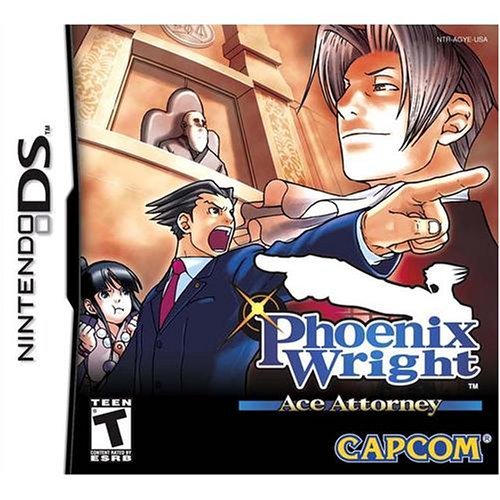
Phoenix Wright: Ace Attorney


 Phoenix Wright: Ace Attorney is part of a very successful game franchise developed by CAPCOM about literally, lawyering. Different cases are presented in each chapter, with a variety of different characters and with over-arching story arcs throughout the series. You play as the titular character, Phoenix Wright, as you can solve these cases as the underdog lawyer who simply believes in the truth.

So how you play this?


The original trilogy of the Phoenix Wright games were originally produced for the Gameboy Advance platform, before being ported and re-packaged for non-Japanese speaking countries on the Nintendo DS. Hence, the game mechanics of the games are quite basic (an additional chapter specially made for the NDS Ace Attorney port featured several Nintendo DS exclusive features).

The franchise has been described as an interactive visual novel by some gamers (it is an established genre in Japanese games). Playing as the main character, they talk to various characters and investigate various scenes in order to gather up clues and evidence to help their client in court.


While exploring, gamers have four choices of actions within a location. They can Examine the location for additional clues, picking points of interest on-screen with the stylus or direction pad; Move allows them to go to another location that is linked to the current one; Talk allows them to talk to the character in the location; and finally Present allows Phoenix Wright to present a piece of Evidence or a Profile to the character in order to gain more information or a reaction.


The Court Record is basically the inventory screen for Phoenix Wright, displaying all the evidence, clues and his permanent Attorney's badge he has at his disposal in order to use in court.


As this is game about a lawyer, typically the most dramatic moments in the game happen in the courtroom. They are handled as a battle of wits between the defense attorney Phoenix Wright, and the Prosecutor intent on declaring his client guilty.

"Rounds of battle" occur with the currently called witness first declaring his testimony. Phoenix Wright is then allowed to Cross-Examine the witness, in order to discover contradictions in their testimony, usually by Presenting contradicting evidence or information.


The ultimate goal is for Phoenix Wright to get his client declared Not Guilty, as he trusts his clients to be completely innocent (barring certain plot-points, this is usually true). As all the cases involve a form of murder, this process also includes discovering the plot and murderer behind each case.

What makes this game memorable

A lot of kudos must be given to to the English localization team in charge of the Phoenix Wright franchise and spin-offs. In a game that revolves around listening to testimonies and logical thinking, the game's script is most important. Character dialogues are coherent and detailed enough that gamers are allowed to make logical decisions and reasoning, without having to blame any stuck point based on a lousy incomprehensible script.

In short, the game's script does not insult the player's intelligence.


At the same time, the localization writers found opportunity to pepper the games with pop culture references, and to give each character their own unique personalities to make them endearing and important to the player.


What has made the Phoenix Wright franchise endearing and successful is the attention and detail given to its characters and story. Every character is memorable, and their backgrounds, motivations and effect on one and other are not one-off and continue through each iteration of the series.

Scenes in the courtroom often escalate into dramatic tension and revelations. Nothing is more satisfying than getting your client a clear Not Guilty verdict (in most cases), but even more so is the ultimate conclusion and final resolution of the truth behind every crime. These moments can match up to the best of the courtroom dramas seen on television.

As such, the entire series is more of an interactive crime drama than game perhaps, or the best example of Japan's unique visual novel genre for a Western audience.

Current status: Phoenix Wright trilogy concluded, Apollo Justice (continuing), Miles Edgeworth Investigations (spin-off); immense amounts of merchandise and official fan/artbooks


Chrono Trigger - Setting the Standard with 2D Sprites and 16-bit music


It's hard to imagine now, the sort of impact Chrono Trigger must have made in the gaming community in 1995 when it was released. It featured the most vibrant graphics ever seen on the aging Super Nintendo hardware, a memorable and inspiring soundtrack, and an immersive and an epic storyline that still puts many modern Japanese Role-Playing Games (JRPG) to shame.

What Chrono Trigger is about?

Chrono Trigger is a Japanese Role-Playing Game (JRPG), published by Squaresoft (in the present now merged with Enix to form Square-Enix), as famous for its JRPG and Final Fantasy franchise in the past as it is today. Yet Chrono Trigger was not part of Squaresoft's Final Fantasy stable, or any other franchise under the company's name at that time.


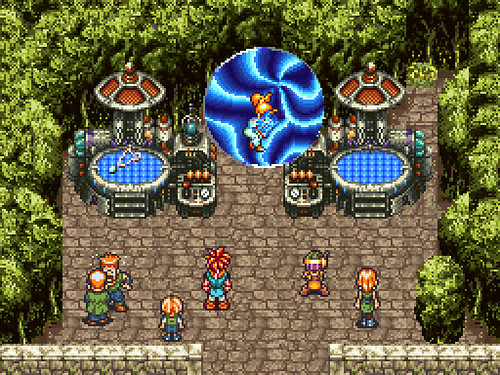
You play as Chrono, a simple farmboy attending a local fair with your inventor friend, Lucca. Chrono accidentally bumps into a strange girl called Marle, whom she shows around the fair. Unfortunately, an accident with Lucca's transporter opens a hole in time that sucks Marle into the past, and Chrono and Lucca must save her. In the process however, they discover their past, their future, and a slumbering alien deep in the earth that awaits them at The End of Time. As they discover new enemies, they discover new allies and friends as well through their journey from prehistoric times to a post-Apocalyptic future.

Exploring and Battling


 As a JRPG, Chrono Trigger's gameplay revolves around world exploration and battling creatures, predominantly the latter. When not in combat, players control Chrono and any 2 of his companions and can move around the game world, interacting with select objects and talking to Non-Player-Characters (NPCs). Depending on the environment, players would have to solve puzzles or find certain objects and NPCs in order to advance the plot.


Battling is handled more dynamically and immersively than in previous JRPGs by Squaresoft and those seen on the SNES. A key feature was the lack of loading screens. Previous JRPG games would require the game to spend some time loading a separate screen on which the monsters and players would battle. In Chrono Trigger, this was done away with and the on-screen exploration screen served as the battle screen as well.

Another difference was how monsters and players sprites were arranged. In the Final Fantasy games for example, monster would be on one side facing the player and his party companions; in Dragon Quest, a first person POV style was used with no characters shown but a frontal view of the monsters instead. Furthermore, all the sprites used for the monsters and characters were static or with very minimal animation.

Chrono Trigger was visually superior, with fully animated sprites with idle animations and various different 'move' animations. Instead of a static arrangement, battles had the monsters and characters spread out randomly, though with the player having no control over the arrangement.

This feature had a tactical property. Players had 3 choices in combat. The standard Attack, using Items, or using Tech. Tech included the standard 'magic' style attacks, as well as special combo moves. These combo moves changed depending on the party make-up chosen by the player, and would include from 2 to 3 different characters. Several of these Tech moves had a certain area of effect, hence positioning would affect the effectiveness of certain moves.

This gave players unparalleled tactical flexibility that was not seen yet in JRPGs. The lack of loading screens made battling feel all the more immersive, and the fast pace of the battles meant that battling in Chrono Trigger felt more action-oriented than in the other JRPGs of the time.


The First 15 Minutes


It opens with a panning shot of a large town near the coast. Balloons and fireworks float past the screen as they rise up to the sky, past the idling clouds that move with the sea winds. There's the sounds of celebration far below, and then the horn and chugging of a ship entering the port.

You talk with your mom, who hands you some money and you meet up with your neighbour and friend to head to the fair.


It's a huge fair, with many, many things to do, you just can't wait!


Until you bump into a strange girl who ran out from nowhere! Thankfully, she's unhurt, and you spend the rest of the time at the fair with her as a companion as your explore it.

Unfortunately, at the last moment when you went to watch Lucca's demonstration of her transporter, a hole in time appears and sucks the girl, Marle, away. Even more unfortunate, she was the princess.


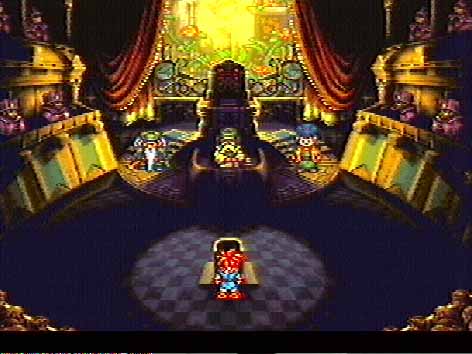
You get pulled into a courtroom, and a list of your deeds, good and bad are read out. This is where you find out that ALL the various actions you've taken throughout the game till now, was being monitored. For example, when you bumped into Marle, whether or not you helped her up first or picked up the shiny amulet she dropped first is brought into question; with the latter being the worse reflection of your character. If you had lost health from one of the trial battles you could take part in earlier, and you saw a lunch left on a table and ate it to regain health, the owner of the lunch accuses you of theft within court.

This is the point perhaps, that best exemplifies Chrono Trigger's scale of story and immersion. You the player is being judged on your actions, and actions that in other JRPGs, have no consequence. In a typical JRPG, the player could basically ransack any house or object for something usable. In this scene, you are judged on your character based on that action. This form of almost karmic retribution would be used in many Western RPGs that would expand its impact on the player game wise - e.g. in the Elders Scrolls series, Fable series, and RPGs created by Bioware - but to my knowledge, has not reappeared in any other JRPG since.

This court scene is also a precursor to the cause-and-effect consequences when the player eventually can jump through different time periods at whim. Doing something in an earlier timeline would then have a visible alteration in the later timelines.

A Hallmark

Without a doubt, Chrono Trigger is a hallmark of game design and scope. Despite being in the declining years of the SNES, the veterans of the JRPG genre, to name a few - Hironobu Sakaguchi, the father of Final Fantasy and arguably the JRPG genre, Nobou Uetmatsu, famed music composer of nearly all of Squaresoft's JRPG games, and Akira Toriyama the famous manga artist of Dragon Ball fame - combined their talents to create the last swan song for the game system.

In 2 years from Chrono Trigger's release, Final Fantasy VII was released on the Sony Playstation, ushering in a new era for JRPGs on 3D consoles. However, noone would deny Chrono Trigger's place in video game history for it's successful melding of an action-oriented and tactical game system and compelling and touching story in a brightly animated and colorful world.

Even now, in the top 100 or top 10 lists of various gaming websites and magazines, there is a guarantee that Chrono Trigger would make an appearance. It has also been re-released on the Nintendo DS, virtually unchanged (after all, nothing was broken), giving a whole new generation a chance to experience it for themselves.

Template by Oriol Sanchez | blogger template by blog forum